Hall of Honor (Sala de Onoare)
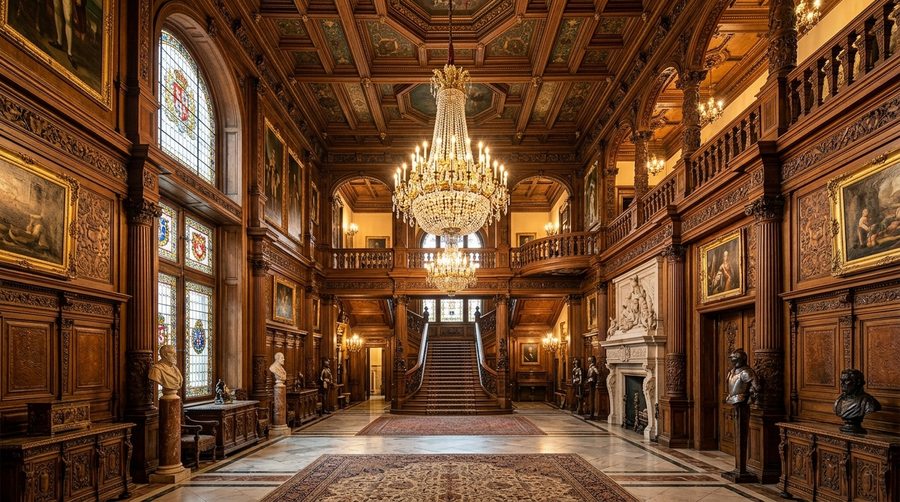
The Hall of Honor — retractable glass ceiling, carved walnut balconies, and original cast-iron railings.
The entrance hall is the castle's showpiece room and the one you've seen in most photographs. The ceiling is retractable — King Carol I had it designed so that it could be opened on warm evenings, turning the hall into an open-air reception space. Carved walnut balconies run along all four sides. The staircase that leads upward from here has the original cast iron railings installed during construction.
Look up at the stained glass lantern above the centre of the space. It was designed to filter daylight into the lower hall throughout the day — a feat of 19th-century engineering that still works exactly as intended.
The Armoury (Grand Tour only)
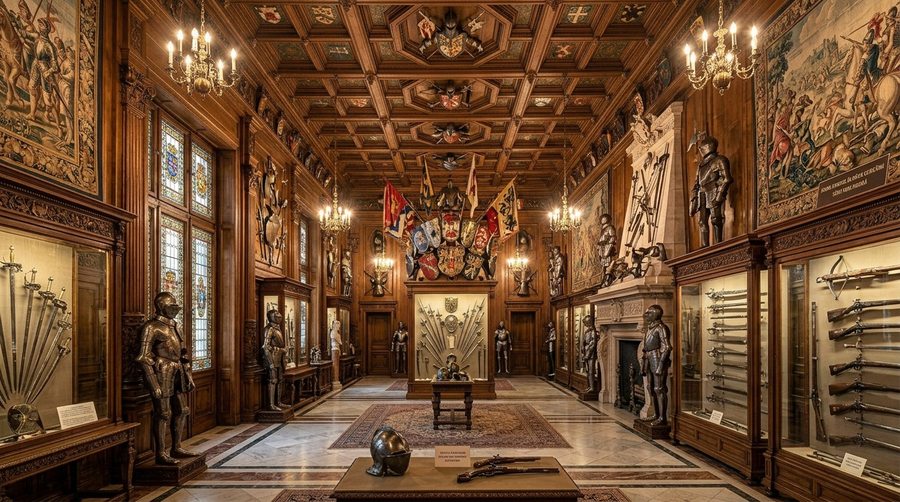
Over 4,000 weapons and armour pieces spanning five centuries — one of the finest collections in southeastern Europe.
The armoury at Peleș is not a side room. It is one of the most significant collections of arms and armour in southeastern Europe, with over 4,000 pieces spanning five centuries — from 15th-century plate armour to 19th-century firearms. Carol I assembled it personally over decades, purchasing pieces at European auctions and commissioning reproductions of historically significant items.
The armour suits are displayed on full mannequins in period-accurate configurations. Several suits have accompanying weapons, shields, and horse armour. The firearms collection includes hunting rifles commissioned for the Romanian royal family, Ottoman pistols, and a series of matched duelling sets. The room's vaulted ceiling and deliberately dim lighting give it the atmosphere of a genuine medieval armoury rather than a display case.
Turkish Salon (Salonul Turcesc)
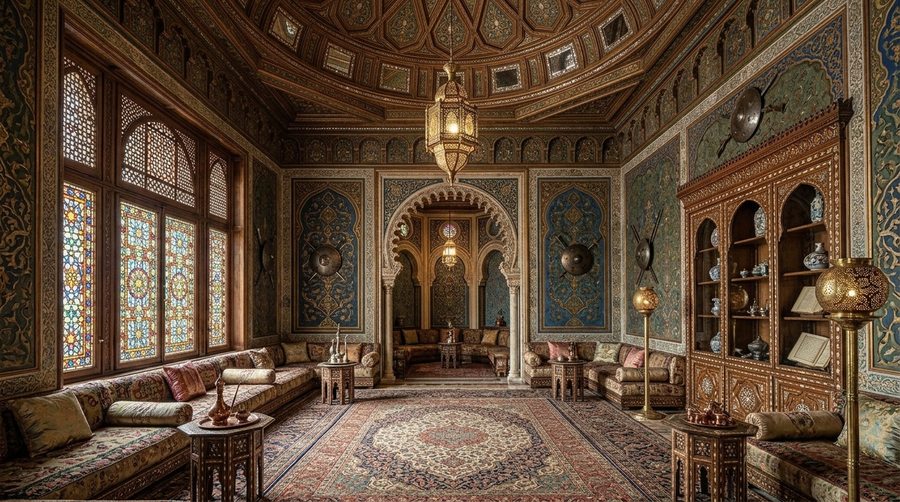
The Turkish Salon — a carved cedar muqarnas ceiling and Ottoman craftsmanship inside a Neo-Renaissance palace.
The Turkish Salon is the room that wrong-foots most visitors. You walk out of Neo-Renaissance rooms with Flemish tapestries and enter a space with a carved cedar muqarnas ceiling, low divans covered in Turkish kilims, hookahs in glass cases, and decorative tilework on every surface. It looks like it belongs in Istanbul, which is roughly the point.
Carol I was fascinated by Ottoman craftsmanship and collected extensively. The room was designed as a private smoking salon and retreat in the Moorish tradition. The cedar ceiling took Romanian craftsmen over a year to complete, working from architectural drawings of Ottoman palace interiors. It remains one of the most photographed rooms in the castle — buy the photography pass before entering.
Private Theatre (Grand Tour only)
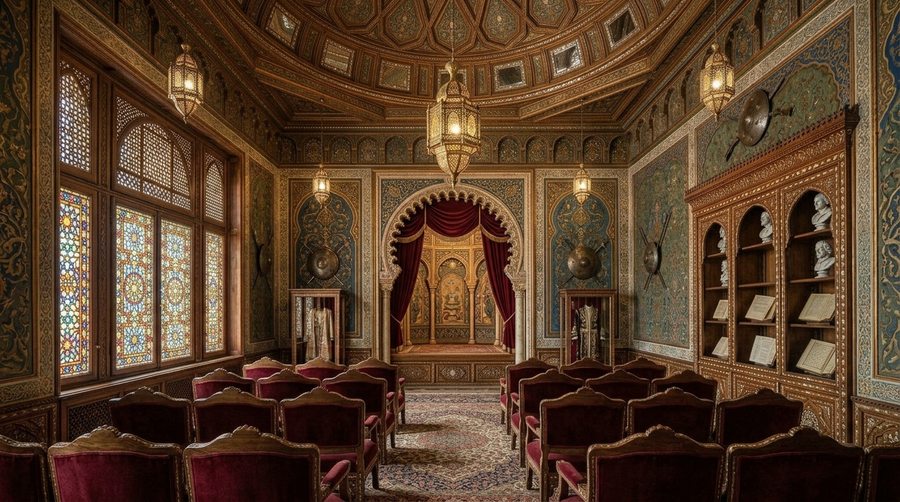
The 60-seat private theatre — original velvet seating, gilded proscenium arch, and gaslit footlights converted to electric.
King Carol I's private theatre seated 60 guests and had working gaslit footlights at the time of construction — later converted to electric. The proscenium arch is carved and gilded. The seating is in the original velvet. The acoustic design is surprisingly good for a room of this size, which is to say it was clearly designed by someone who understood the difference between a showpiece room and a functioning theatre.
It was used for performances throughout Carol I's reign and into the reign of Ferdinand I. After the Second World War and the nationalization of the castle, it fell out of use and has since been preserved rather than actively programmed. The stage still exists behind the proscenium.
Royal Library (Grand Tour only)
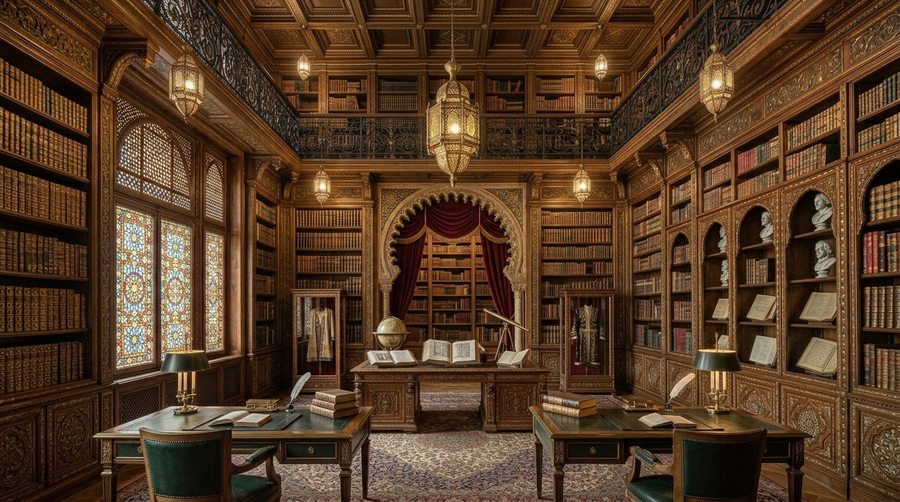
The Royal Library — 10,000 volumes in floor-to-ceiling carved walnut shelving, still arranged as they were left.
The library contains approximately 10,000 volumes in original carved walnut shelving that reaches from floor to ceiling. The collection spans medieval manuscripts, illustrated natural history atlases, military histories, royal correspondence archives, and the personal reading collection of Queen Elisabeth (who wrote poetry and prose under the pen name Carmen Sylva).
The reading table at the centre of the room is original. The portable wooden library steps are still in place. Most of the books are behind glass but the shelving itself is accessible, and the sheer density of the collection — in a room that still looks like it was in active use when someone left — is the main impression the room leaves.
Imperial Apartments (Grand Tour only)
The private apartments of King Carol I and Queen Elisabeth are the most personally revealing spaces in the castle. Unlike the state rooms below, these were lived in daily and reflect specific tastes rather than protocol. Carol I's study is arranged around a large desk with a view of the mountain forest. The bedroom furniture is German Renaissance revival — the same style he grew up with in Sigmaringen. Queen Elisabeth's rooms are lighter and more personal, filled with the material she collected during decades of residence: devotional objects, photographs, embroideries she made herself.
A small adjoining dressing room contains personal effects — hairbrushes, a writing set, travel accessories — that sit behind glass exactly where they were left. It is the most human corner of an otherwise monumental building.
Pelișor Castle (separate ticket, 300m away)
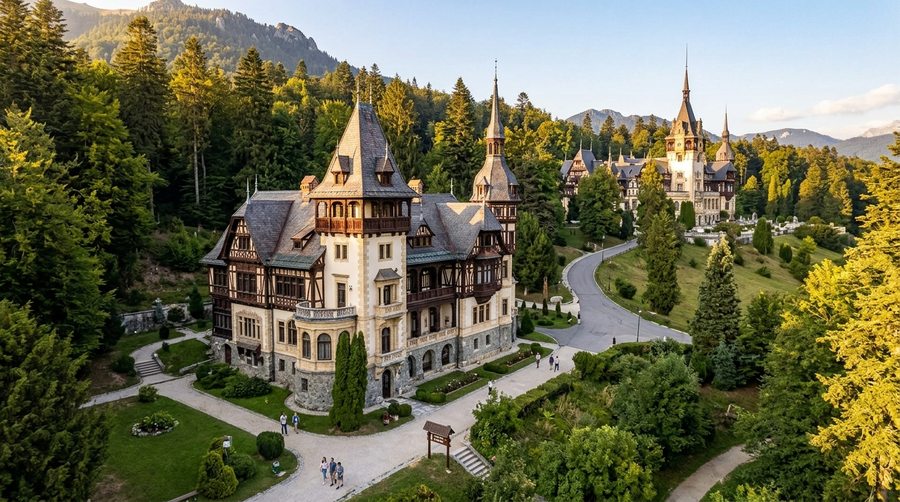
Pelișor Castle — Queen Marie's Art Nouveau retreat, 300 metres up the hill from Peleș.
Pelișor ("Little Peleș") was built between 1899 and 1902 for Crown Prince Ferdinand and his wife, later Queen Marie of Romania. Where Peleș is Neo-Renaissance and German in character, Pelișor is Art Nouveau — an entirely different aesthetic. Marie's Gold Room, covered in Byzantine-influenced golden mosaic, is the most distinctive space. The furniture was designed by the same Vienna Secessionist workshops that furnished the Wiener Werkstätte's most notable commissions.
It's a smaller building than Peleș — around 70 rooms — but worth the additional 30 RON entry if you have time. The contrast between the two buildings is instructive: two generations of the same royal family with completely different architectural instincts, 300 metres apart.